At the family table / p. 1407
A week of dinners
Section 3149 · No. 1View source ↗
Who eats what—and what happens to the food between meals? Explore the family dinners and servants’ dinners recommended in the same household manual.
Select the number of servants named in the heading.
How to read this comparison. These are two sets of recommendations, not a matched menu for one documented household. The servants’ headings give group sizes, not weekdays. Neither section provides the family’s income or a price for these meals.
These original designs show how the book imagined a menu being made and presented. They are design examples, not evidence of the meals in our August comparison.
Original scans: University of Leeds Library / Internet Archive · Public Domain Mark. Select an image to enlarge it and read its source caption.
Follow a stated transfer, a possible sequence of reuse, or the work that connects preparation to presentation.
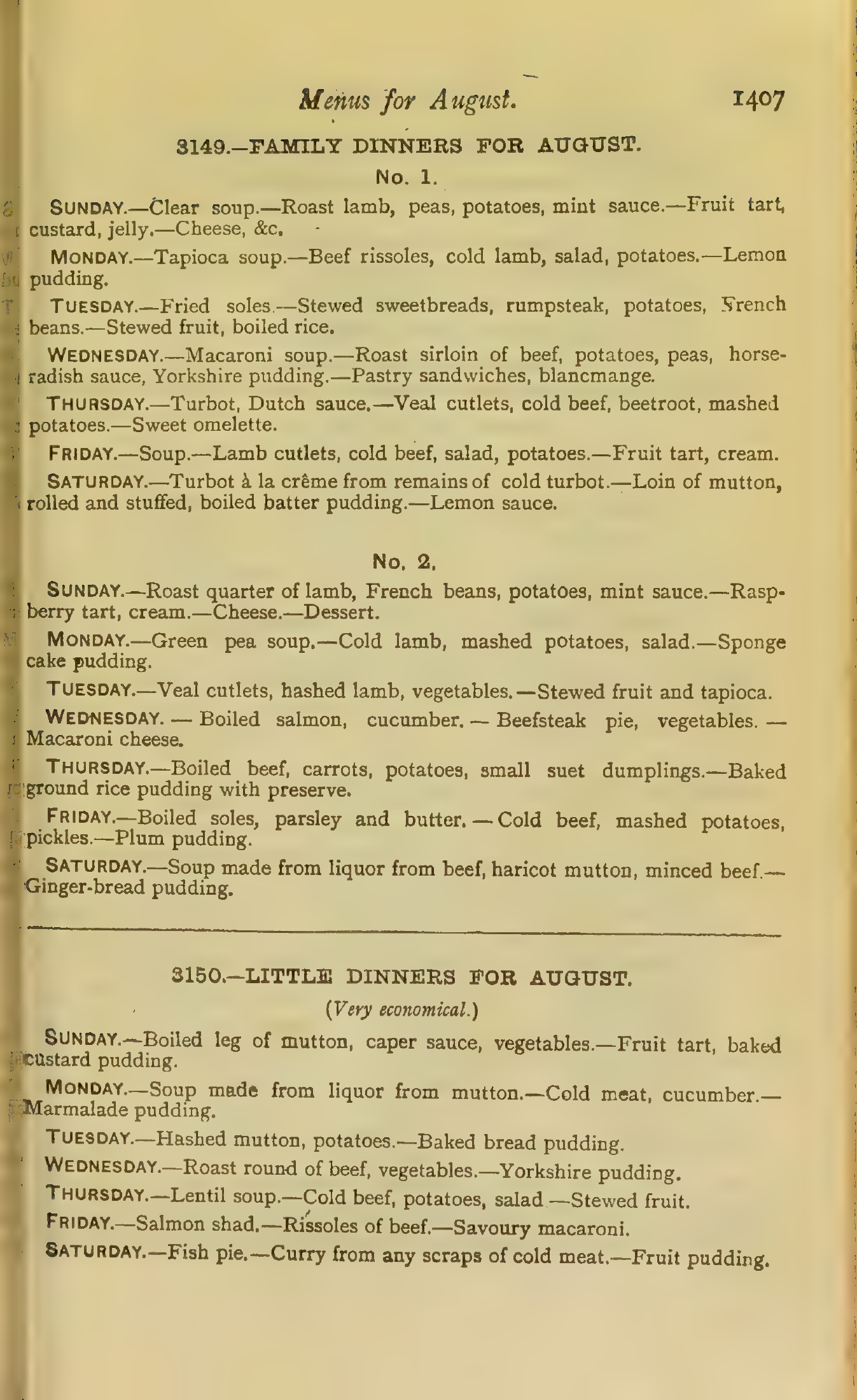
Printed p. 1407 · sections 3149–3150. Two family plans and a third plan labelled “Very economical.”
Open on Internet Archive ↗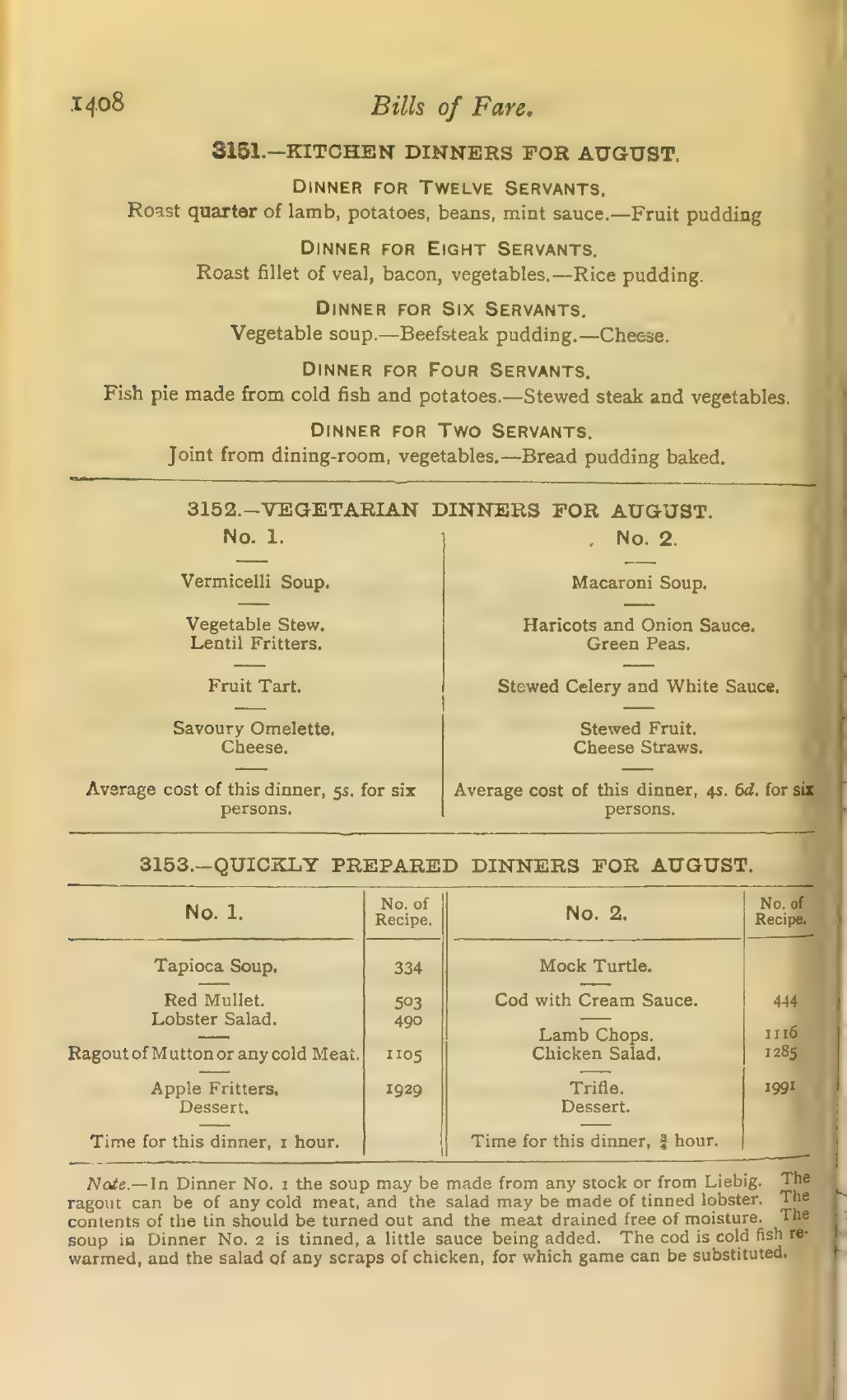
Printed p. 1408 · section 3151. Menus for twelve, eight, six, four, and two servants. The prices lower on this page belong to vegetarian dinners.
Open on Internet Archive ↗Recommended menus printed in the book, not records of meals actually eaten. Family days and servants’ group sizes are independent choices; the book does not pair them as one observed household. Line breaks and typography are normalised. No class, income, family size, meal price or recipe identity is inferred from a menu heading alone.
The 21 daily family/little-dinner entries were checked against printed p. 1407; the five servants’ menus against printed p. 1408. Both source images are included. These two leaves have PDF sequence pages 1517–1518, while the downloaded page-number index identifies Archive leaves 1521–1522; printed page and local scan are the primary references. Prices shown lower on p. 1408 belong to the vegetarian menus, not the servants’ meals, and are not attached to this comparison. ‘Salmon shad’ and ‘crême’ are preserved as printed. Course group breaks follow the printed em dashes; ingredient chips and highlights are editorial aids, not additional historical classifications.
The source is University of Leeds Library’s copy of The Book of Household Management, Internet Archive b21536193, catalogued as 1899. Its preface is dated November 1888. Scans are credited to the University of Leeds Library / Internet Archive, whose item record carries a Public Domain Mark.
Read all 26 menu entries and the evidence notes →“Bread pudding baked” appears at the two-servant table. The menu supplies no recipe number, so we cannot identify it as our Very Plain Bread Pudding.
Explore the three researched recipes →The manual recommends staffing at different income levels elsewhere. Those recommendations give context; they do not assign a household income to these menus.
Read the income and wage evidence →Open an itemised dinner estimate for six. Explore the food prices, then look beyond the total to equipment, preparation and costs not separately shown.