$6,000
December 1886 bazaar
Described as “cleared.” Printed p.704.
Research prepared 1 November 2026. A first evidence record for the exhibition; interpretations remain provisional.
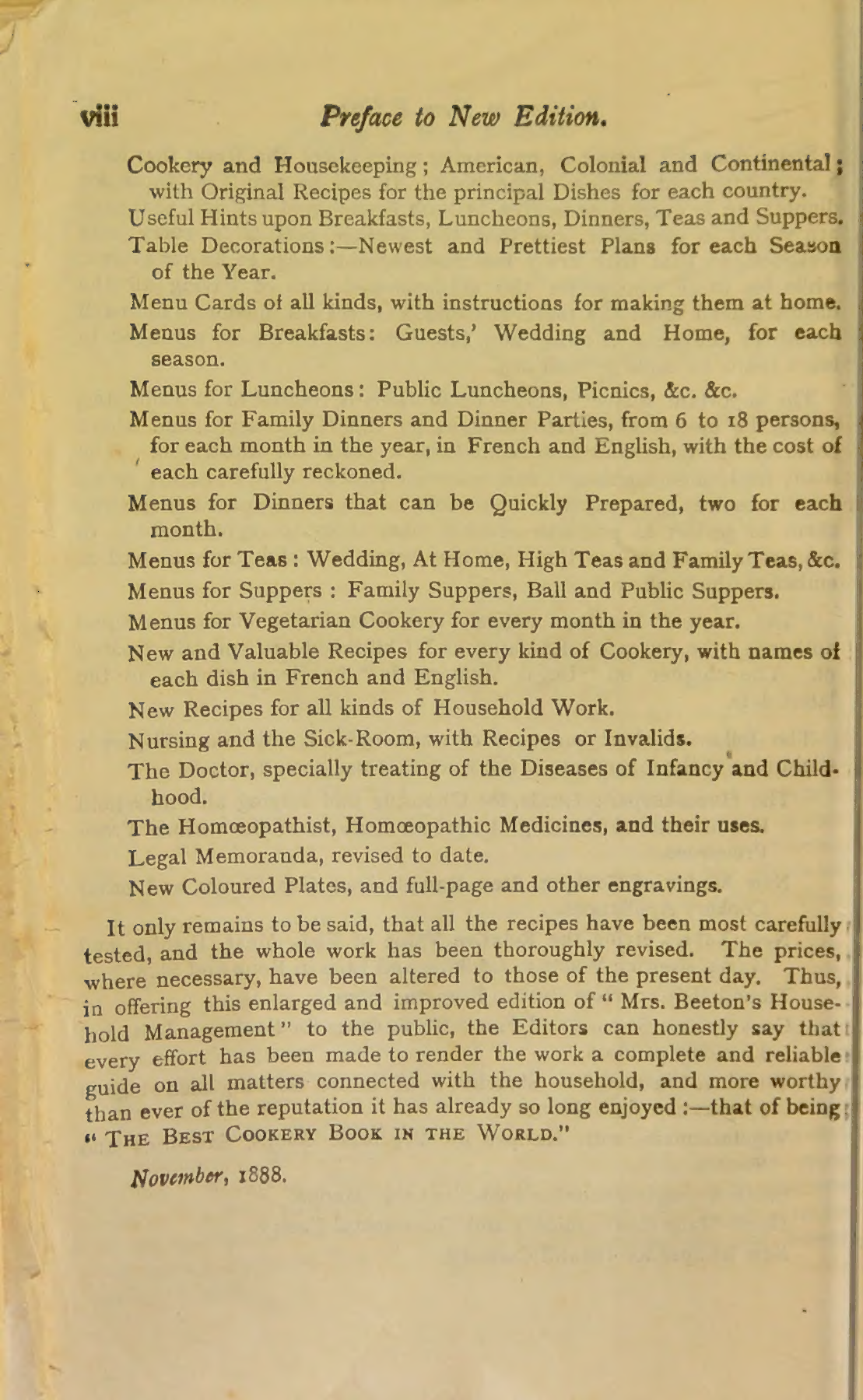
Edition and dating. Internet Archive b21536193; catalogued as 1899. Preface dated November 1888. Prices are estimates printed in this copy, not independently observed 1899 transactions.
Reading transcriptions checked against the scanned pages. Paragraphs and line breaks are normalised; line-end word divisions are joined; typographic fractions are rendered as Unicode fractions. Square brackets mark editorial reconstructions at the faded or cropped outer margin. No wording has been silently borrowed from another edition. These are historical documents, not modern cooking instructions.
The source’s outer margins are partly faded or cropped. Reconstructed words are deliberately visible. These are reading transcriptions, not certified diplomatic editions. The recipe time, recipe cost, yield and historical title are preserved separately from modern explanation.
| Recipe / page | Printed average cost | Yield or limitation |
|---|---|---|
| Very Plain Bread Pudding No. 1731, p. 824 | 6d., exclusive of the bread. | Sufficient for 6 or 7 persons. |
| Raised Pie of Poultry or Game No. 1852, p. 870 | 5s. 6d. | No fixed number of diners is given; the recipe allows one or more birds according to pie size. |
| Lemon Jelly No. 2004, p. 937 | 2s. 2d. | Sufficient to fill 1½-pint mould. |
Exact Internet Archive source page ↗ · Local source image
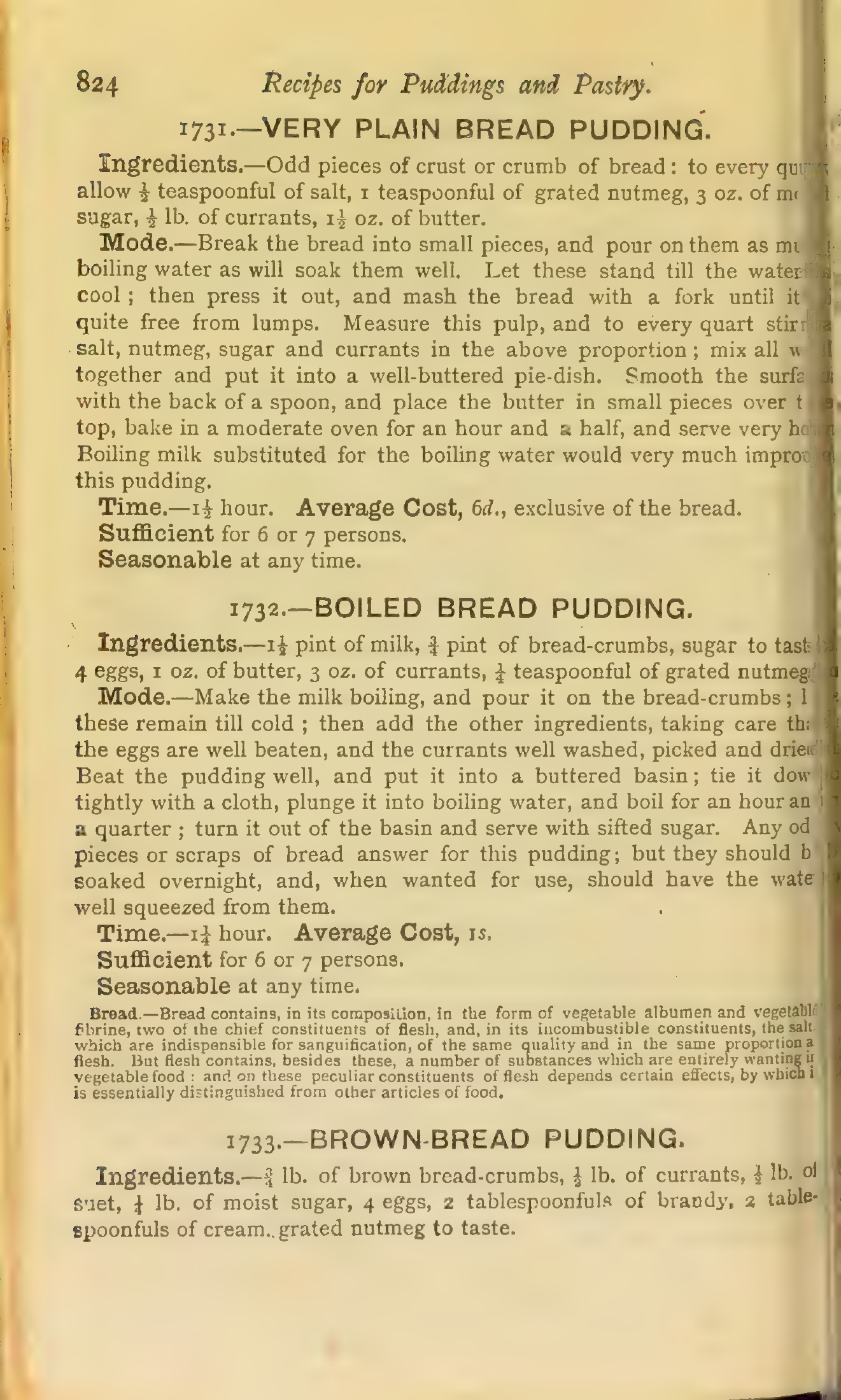
Ingredients.—Odd pieces of crust or crumb of bread: to every [quart] allow ½ teaspoonful of salt, 1 teaspoonful of grated nutmeg, 3 oz. of [moist] sugar, ½ lb. of currants, 1½ oz. of butter.
Mode.—Break the bread into small pieces, and pour on them as [much] boiling water as will soak them well. Let these stand till the water [is quite] cool; then press it out, and mash the bread with a fork until it [is] quite free from lumps. Measure this pulp, and to every quart stir [in the] salt, nutmeg, sugar and currants in the above proportion; mix all [well] together and put it into a well-buttered pie-dish. Smooth the [surface] with the back of a spoon, and place the butter in small pieces over [the] top, bake in a moderate oven for an hour and a half, and serve very [hot.] Boiling milk substituted for the boiling water would very much [improve] this pudding.
Time.—1½ hour. Average Cost, 6d., exclusive of the bread.
Sufficient for 6 or 7 persons.
Seasonable at any time.
Verification: Recipe number, page, fractions, 90-minute baking time, yield and cost qualification checked against the scan. The right outer margin is faded/cropped. Bracketed words are editorial reconstructions, not fully legible readings; retain them until a clearer image of this edition is found.
This is direct evidence of an ideal of household thrift and of accounting that treats existing bread differently from new purchases. It is not proof of working-class consumption. The optional milk also makes visible a choice between a cheaper base and an enriched version, though the price of that substitution is not supplied.
Class unassigned. Economy and reuse are explicit; the actual consumer’s occupation, income and social position are unknown.
Unknown. The soaking, pressing, mashing and oven tending could be performed by a household member or paid worker; the recipe does not identify one.
Ninety minutes is the stated baking time, not a measurement of total labour. Cooling, preparation, heating the oven, fuel use and cleaning are not separately costed or timed.
Sixpence is an incomplete dish cost: bread is explicitly excluded. Do not label it free food, a complete meal, or an observed purchase. The printed estimate does not separately identify fuel, equipment or labour charges.
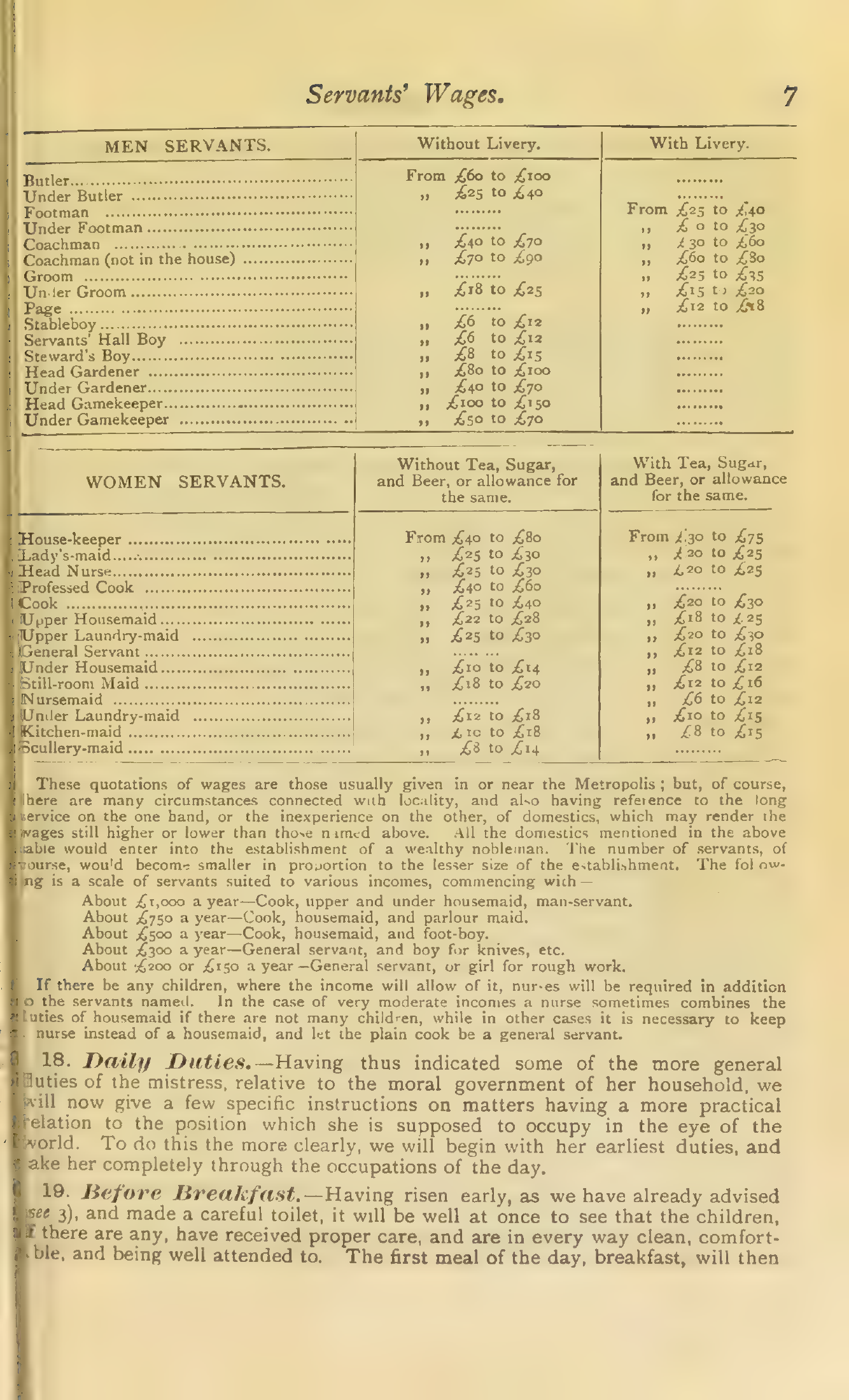
No recipe-specific income evidence. Read with the manual’s staffing scale on p. 7, not as a dish assigned to one income band.
Primary source for all three recipes. University of Leeds Library copy; Internet Archive catalogue date 1899; Public Domain Mark. Recipe numbering belongs to this copy.
Dated November 1888. Editors say prices have been altered where necessary. This does not date each individual price revision or establish when the selected recipes first appeared.
Manual’s own prescriptive economic context. It locates the wage quotations in or near London and warns of variation by locality, experience and service. Cook: £20–£30 yearly in the column including tea, sugar and beer, or an allowance; £25–£40 without those items. General servant: £12–£18 in the former column. Do not treat cash wages as total compensation or household income.
The Shibden account describes the cook’s cleaning duties as well as food preparation, and explains that assistants and duties varied with establishment size. It helps frame labour beyond the recipe’s stated cooking time; it does not prove that Shibden served these dishes.
Currency arithmetic only: £1 = 20 shillings = 240 old pence; 1 shilling = 12 old pence. No modern purchasing-power equivalence is asserted.
Exact Internet Archive source page ↗ · Local source image
Pâté froid de Gibier—de Volaille.
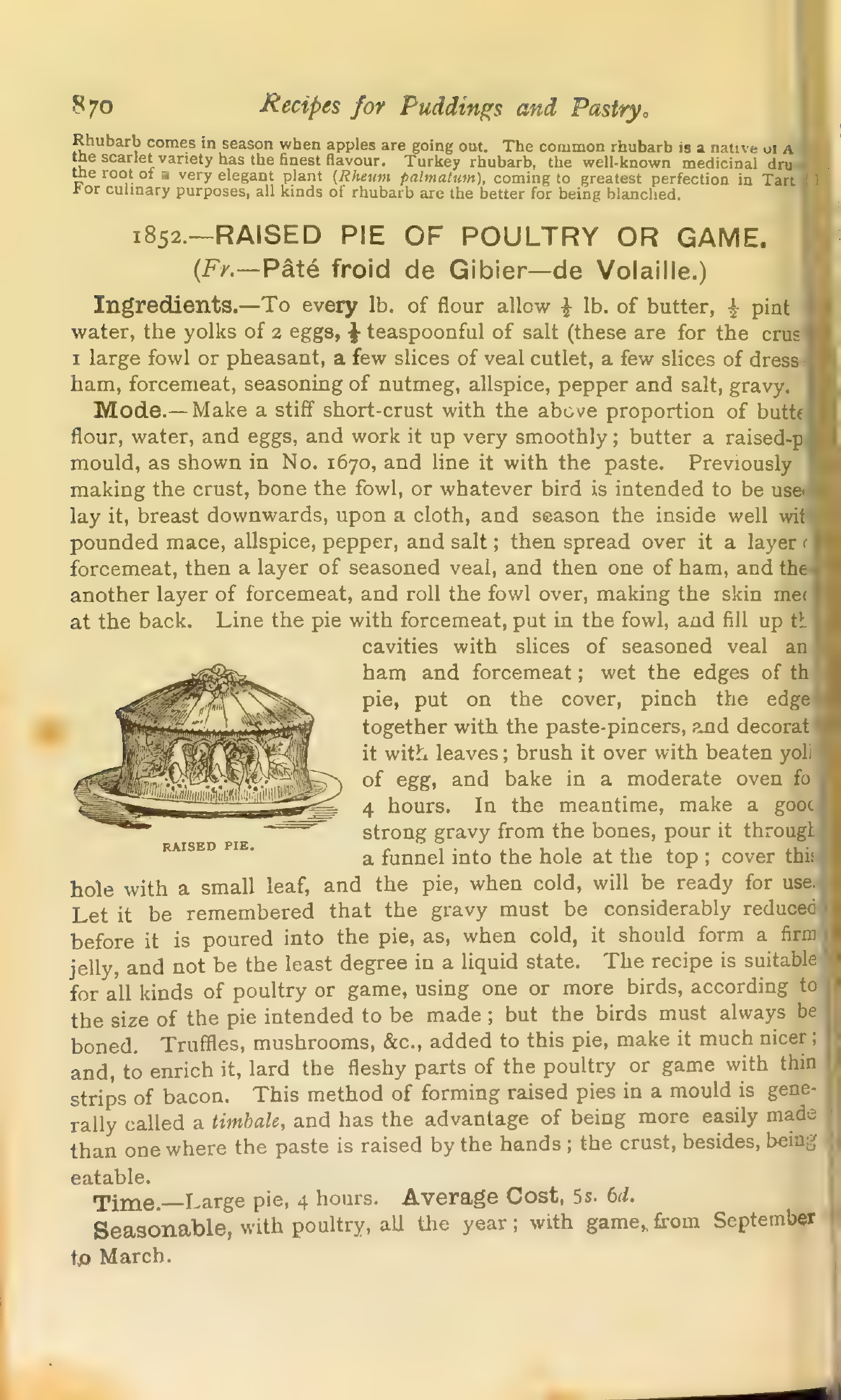
Ingredients.—To every lb. of flour allow ½ lb. of butter, ½ pint [of] water, the yolks of 2 eggs, ½ teaspoonful of salt (these are for the [crust]); 1 large fowl or pheasant, a few slices of veal cutlet, a few slices of [dressed] ham, forcemeat, seasoning of nutmeg, allspice, pepper and salt, gravy.
Mode.—Make a stiff short-crust with the above proportion of [butter,] flour, water, and eggs, and work it up very smoothly; butter a raised-[pie] mould, as shown in No. 1670, and line it with the paste. Previously [to] making the crust, bone the fowl, or whatever bird is intended to be [used]; lay it, breast downwards, upon a cloth, and season the inside well [with] pounded mace, allspice, pepper, and salt; then spread over it a layer [of] forcemeat, then a layer of seasoned veal, and then one of ham, and [then] another layer of forcemeat, and roll the fowl over, making the skin [meet] at the back. Line the pie with forcemeat, put in the fowl, and fill up [the] cavities with slices of seasoned veal [and] ham and forcemeat; wet the edges of [the] pie, put on the cover, pinch the [edges] together with the paste-pincers, and [decorate] it with leaves; brush it over with beaten [yolk] of egg, and bake in a moderate oven [for] 4 hours. In the meantime, make a good strong gravy from the bones, pour it through a funnel into the hole at the top; cover this hole with a small leaf, and the pie, when cold, will be ready for use. Let it be remembered that the gravy must be considerably reduced before it is poured into the pie, as, when cold, it should form a firm jelly, and not be the least degree in a liquid state. The recipe is suitable for all kinds of poultry or game, using one or more birds, according to the size of the pie intended to be made; but the birds must always be boned. Truffles, mushrooms, &c., added to this pie, make it much nicer; and, to enrich it, lard the fleshy parts of the poultry or game with thin strips of bacon. This method of forming raised pies in a mould is generally called a timbale, and has the advantage of being more easily made than one where the paste is raised by the hands; the crust, besides, being eatable.
Time.—Large pie, 4 hours. Average Cost, 5s. 6d.
No fixed number of diners is given; the recipe allows one or more birds according to pie size.
Seasonable, with poultry, all the year; with game, from September to March.
Verification: Recipe number, p. 870, crust ratios, 4 hours and 5s. 6d. checked against scan. Brackets restore faded/cropped outer-margin words. Nutmeg appears in the ingredient list, mace in the method: the discrepancy is preserved. No quantity is supplied for forcemeat or gravy. The reference points to printed p.797: two illustrations below paragraph 1670 show the raised-pie mould assembled and open. Paragraph 1670 itself concerns testing oven heat; it is not a mould-making instruction. Page image checked 5 November 2026.
Layered meats, decoration and specialist operations make skilled culinary display central to this recipe. They establish resource-intensive preparation, without identifying actual diners, an upper-class monopoly or the employment of a professional cook. The manual describes moulding as easier than raising the pastry by hand.
Possible association with resource-intensive entertaining is a curatorial hypothesis. Actual class and household income remain unassigned.
The operations require skill, but the preparer’s employment is unknown. A cook or household member is possible; an individual wage cannot be attached to this recipe.
The four-hour figure describes baking. Boning, forcemeat, pastry, gravy-making and cooling add processes without measured durations; some occur in parallel. Four hours is therefore the stated baking time, not a measure of total labour.
5s. 6d. equals 66 old pence. Bird number and pie size can vary; no defensible per-person price is available. The book does not itemise the cost of optional enrichments, utensils, fuel or labour here.
For context, p. 7 recommends a cook, housemaid and foot-boy for about £500 annual household income. This is a staffing recommendation, not evidence that £500 households served this pie.
Primary source for all three recipes. University of Leeds Library copy; Internet Archive catalogue date 1899; Public Domain Mark. Recipe numbering belongs to this copy.
Dated November 1888. Editors say prices have been altered where necessary. This does not date each individual price revision or establish when the selected recipes first appeared.
Manual’s own prescriptive economic context. It locates the wage quotations in or near London and warns of variation by locality, experience and service. Cook: £20–£30 yearly in the column including tea, sugar and beer, or an allowance; £25–£40 without those items. General servant: £12–£18 in the former column. Do not treat cash wages as total compensation or household income.
The Shibden account describes the cook’s cleaning duties as well as food preparation, and explains that assistants and duties varied with establishment size. It helps frame labour beyond the recipe’s stated cooking time; it does not prove that Shibden served these dishes.
Shibden Hall case study: live-in servants received lodgings; duties and staffing depended on the household. This supports distinguishing cash pay from living resources. It does not establish staffing for an anonymous Beeton reader.
Currency arithmetic only: £1 = 20 shillings = 240 old pence; 1 shilling = 12 old pence. No modern purchasing-power equivalence is asserted.
Exact Internet Archive source page ↗ · Local source image
Gelée au Citron.
Ingredients.—6 lemons, ¾ lb. lump sugar, 1 pint of water, 1¼ oz. of gelatine, ¼ pint of sherry.
Mode.—Peel three of the lemons, pour half a pint of boiling water on the rind, and let it infuse for half an hour; put the sugar, gelatine, and half a pint of water into a lined saucepan, simmer these ingredients for 10 minutes; then put in the strained lemon juice, the strained infusion of rind, and bring the whole to the point of boiling; skim well, add the wine, and run the jelly through a bag; pour it into a mould that has been wetted or soaked in water; put it in ice, if convenient, where let it remain until required for table. Previously to adding the lemon-juice to the other ingredients, ascertain that it is very nicely strained, as, if this is not properly attended to, it is liable to make the jelly thick and muddy. As this jelly is very pale, and almost colourless, it answers very well for moulding with a jelly of any bright hue; for instance, half a jelly bright red, and the other half made of the above, would have a very good effect. Lemon jelly may also be made with patent gelatine, allowing the juice of three lemons to every pint.
Time.—Altogether, 1 hour. Average Cost, 2s. 2d.
Sufficient to fill 1½-pint mould.
Seasonable at any time.
Verification: Recipe number, printed p. 937, all quantities, 1 hour, 2s. 2d. and 1½-pint mould checked against scan. The digital page-number index omits this page label; the printed page number is visible on the scan. No diners count is given. Patent-gelatine alternative is preserved without treating it as a fully specified second recipe.
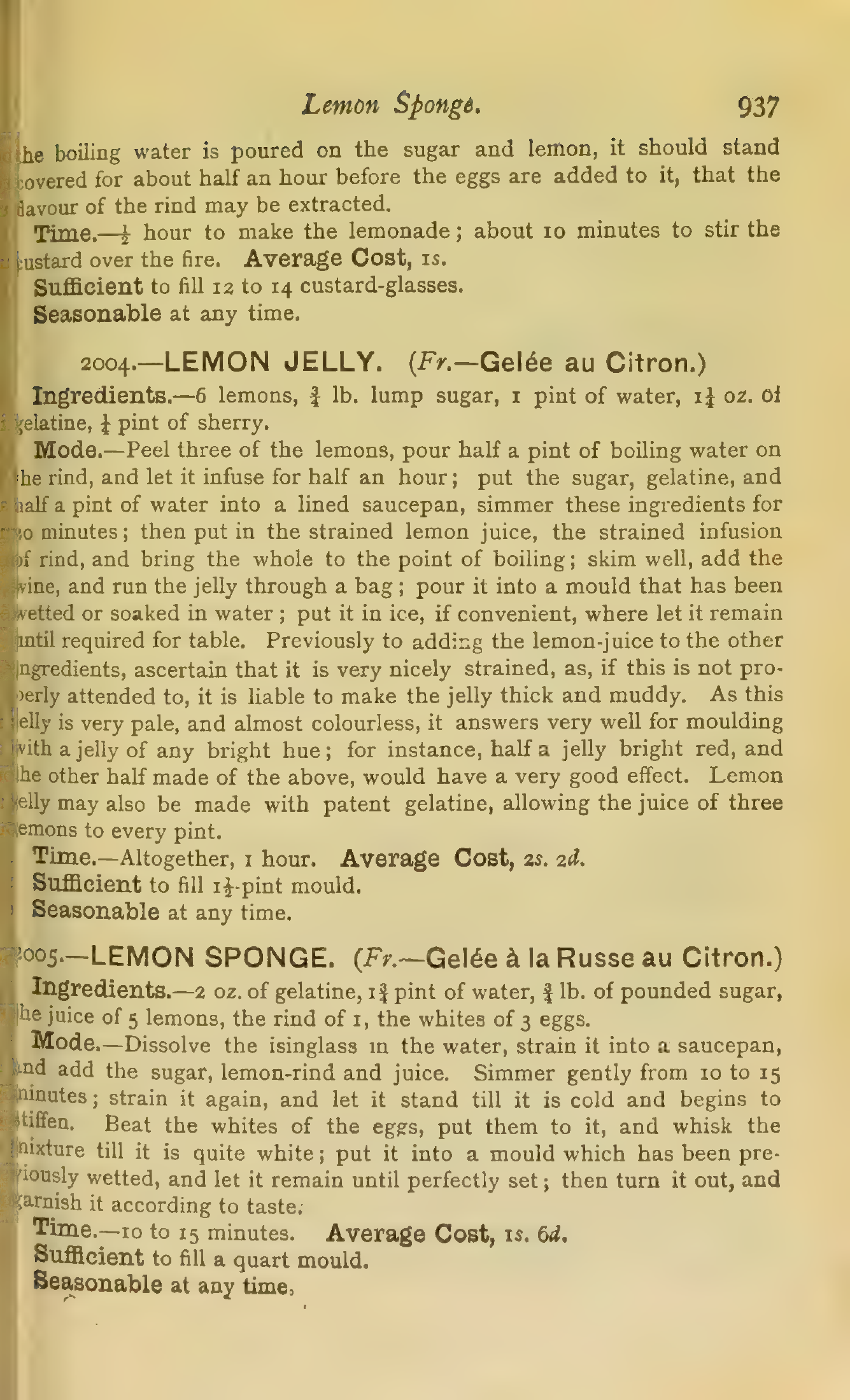
Repeated filtering and the suggested colour contrast show appearance as an objective of preparation. The optional ice invites investigation of cooling access, while sherry and commercial gelatine open questions about household purchasing. These are evidence-led research directions; neither the recipe nor its price proves that only wealthy people ate jelly. No specific trade origin is established for these ingredients in this copy.
Decorative presentation is explicit; an exclusive upper-class association is not established. Actual consumers and income are unknown.
Unknown. Straining, skimming and moulding show work and skill, but do not identify whether the worker was paid.
The book states one hour altogether, yet also tells the cook to leave the mould until required. Record the printed time separately from unknown setting and cooling time; do not present one hour as a verified ready-to-eat duration.
2s. 2d. equals 26 old pence for the recipe’s mould yield. No per-person price can be calculated without an assumed portion size. Ice is optional; possession of an ice-house cannot be inferred.
No income is attached to the dish. The manual’s £20–£30 annual cook’s cash-wage range with specified allowances is contextual, not a measure of the consumer’s budget or the worker’s total resources.
Primary source for all three recipes. University of Leeds Library copy; Internet Archive catalogue date 1899; Public Domain Mark. Recipe numbering belongs to this copy.
Dated November 1888. Editors say prices have been altered where necessary. This does not date each individual price revision or establish when the selected recipes first appeared.
Manual’s own prescriptive economic context. It locates the wage quotations in or near London and warns of variation by locality, experience and service. Cook: £20–£30 yearly in the column including tea, sugar and beer, or an allowance; £25–£40 without those items. General servant: £12–£18 in the former column. Do not treat cash wages as total compensation or household income.
The Shibden account describes the cook’s cleaning duties as well as food preparation, and explains that assistants and duties varied with establishment size. It helps frame labour beyond the recipe’s stated cooking time; it does not prove that Shibden served these dishes.
Currency arithmetic only: £1 = 20 shillings = 240 old pence; 1 shilling = 12 old pence. No modern purchasing-power equivalence is asserted.
The book’s p. 7 places household income alongside recommended numbers and kinds of servants. Its wage table also ranks paid domestic work. These are prescriptions printed in a household manual, not a survey of actual households. They can reveal an imagined social order without identifying who ate the three dishes.
| Annual household income | Recommended servants |
|---|---|
| £150 or £200 a year | General servant, or girl for rough work |
| About £300 a year | General servant, and boy for knives, etc. |
| About £500 a year | Cook, housemaid, and foot-boy |
| About £750 a year | Cook, housemaid, and parlour maid |
| About £1,000 a year | Cook, upper and under housemaid, man-servant |
Cook’s annual cash wage: £20–£30 in the column including tea, sugar and beer, or an allowance; £25–£40 in the column without these items. The general servant is given £12–£18 in the former column. The text identifies these as wage quotations in or near London, subject to variation.
Cash wages are neither total compensation nor the employer’s household income. The Shibden Hall case study describes live-in servants receiving lodgings. Its cook’s work also included cleaning; this helps us look beyond the recipe’s cooking-time line.
A separate London comparison: LSE’s account of Booth’s maps explains the historical legend’s 18s–21s weekly range for a poor moderate family. This is contextual evidence, not a wage assigned to a recipe’s consumer or a threshold for Britain as a whole. No affordability percentage has been calculated: household size, date, resources and comparable yields are not sufficiently matched.
Money notation: 1s. = 12d.; £1 = 20s. = 240d. The pie’s 5s. 6d. is 66d.; the jelly’s 2s. 2d. is 26d. These conversions are arithmetic only, not modern purchasing-power equivalents.
View the wage table and income recommendations · View the dated preface
The three recipes describe prescribed dishes, not observed meals. They do not identify consumers, occupations, household budgets or frequency of consumption. Ingredient provenance, trade routes, national consumption, complete fuel costs and dates of market prices are outside the evidence established here.
Manual’s own prescriptive economic context. It locates the wage quotations in or near London and warns of variation by locality, experience and service. Cook: £20–£30 yearly in the column including tea, sugar and beer, or an allowance; £25–£40 without those items. General servant: £12–£18 in the former column. Do not treat cash wages as total compensation or household income.
Dated November 1888. Editors say prices have been altered where necessary. This does not date each individual price revision or establish when the selected recipes first appeared.
Independent late-Victorian London context: the map legend describes a poor moderate family as having 18s–21s weekly. LSE explains that the 1898–99 maps were published in 1902–03. These historical categories are not neutral modern classifications, a national wage scale, or evidence of the consumers of these recipes.
Shibden Hall case study: live-in servants received lodgings; duties and staffing depended on the household. This supports distinguishing cash pay from living resources. It does not establish staffing for an anonymous Beeton reader.
The Shibden account describes the cook’s cleaning duties as well as food preparation, and explains that assistants and duties varied with establishment size. It helps frame labour beyond the recipe’s stated cooking time; it does not prove that Shibden served these dishes.
Currency arithmetic only: £1 = 20 shillings = 240 old pence; 1 shilling = 12 old pence. No modern purchasing-power equivalence is asserted.
Open the interactive comparison →
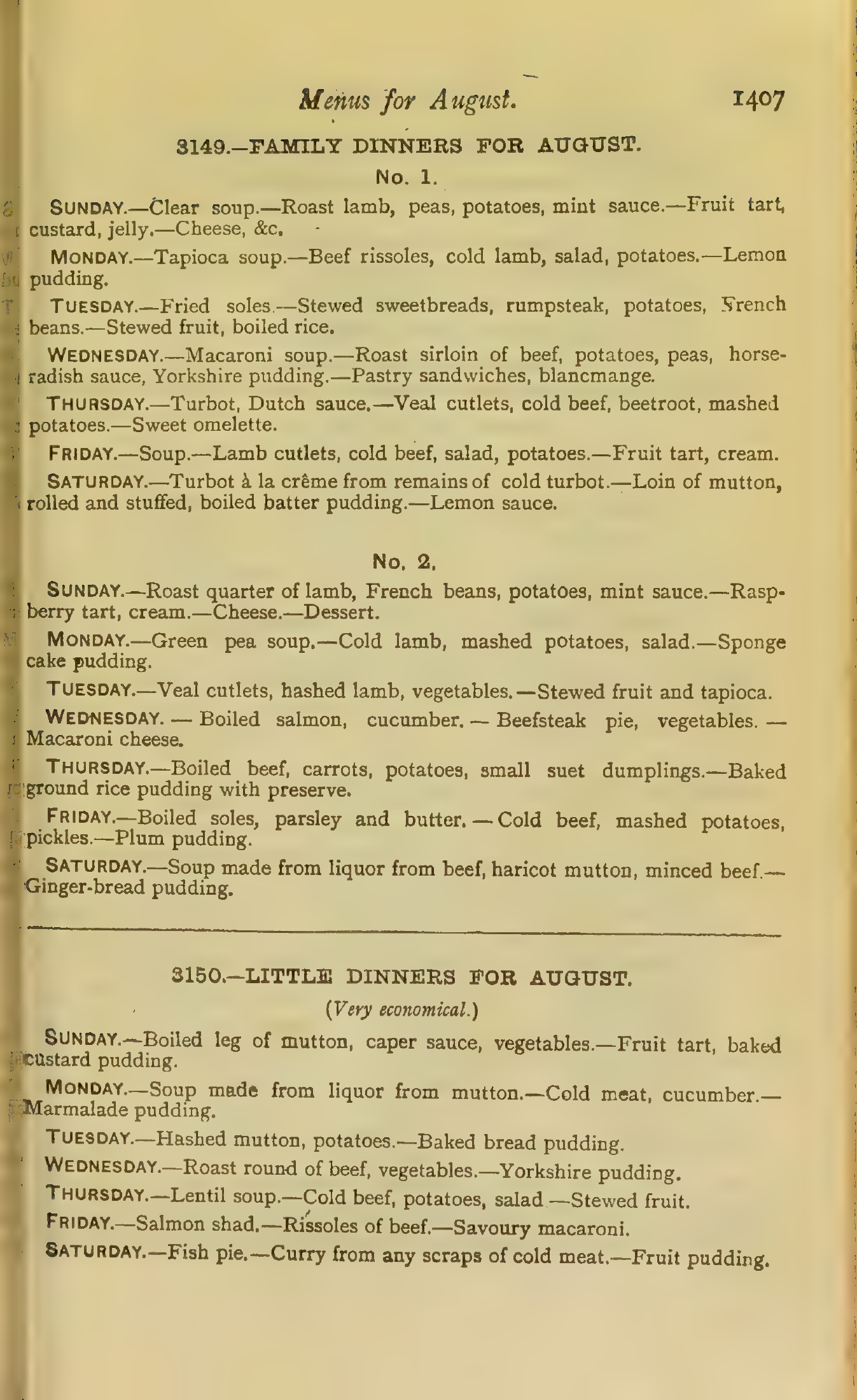
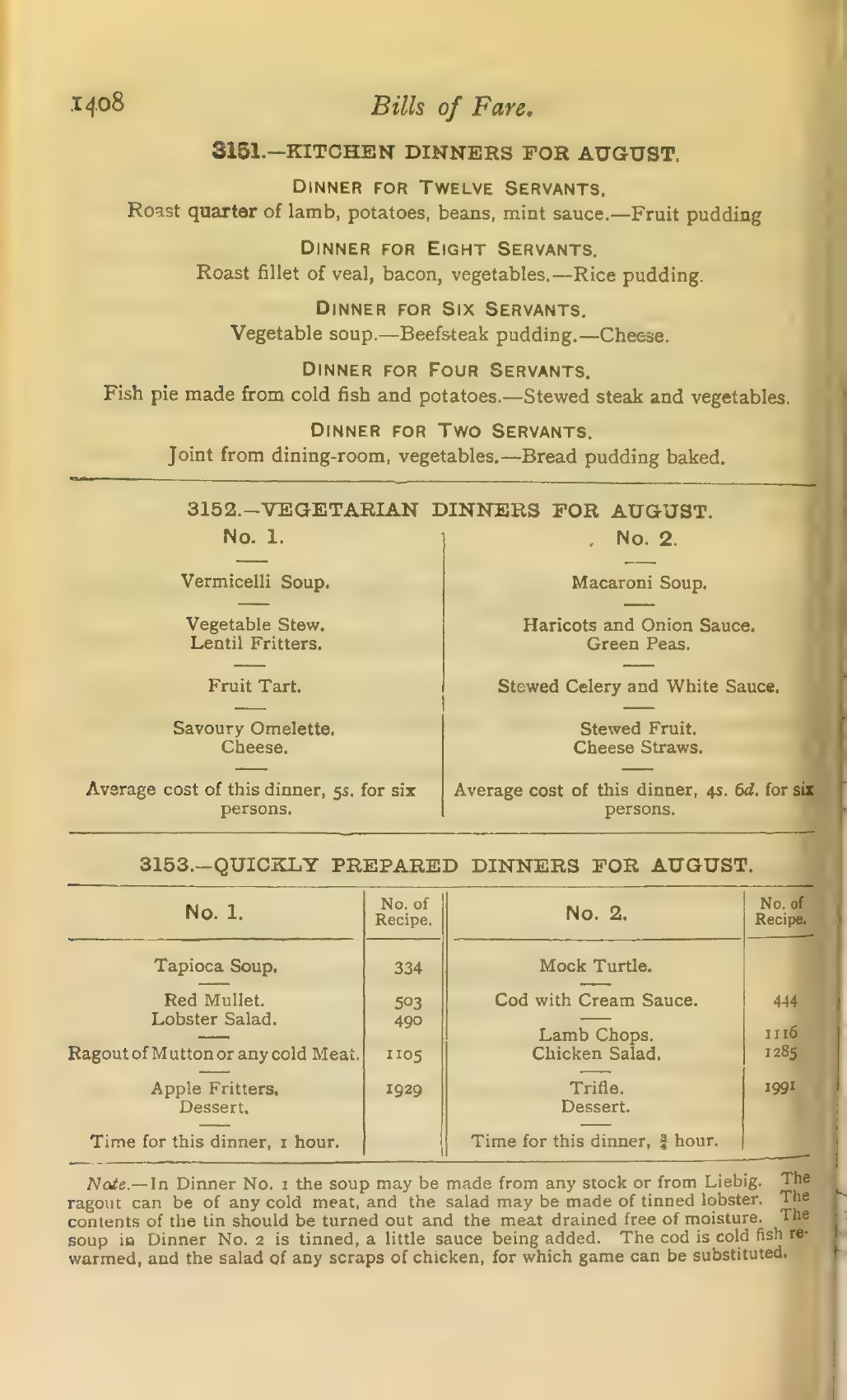
Recommended menus printed in the book, not records of meals actually eaten. Family days and servants’ group sizes are independent choices; the book does not pair them as one observed household. Line breaks and typography are normalised. No class, income, family size, meal price or recipe identity is inferred from a menu heading alone.
The 21 daily family/little-dinner entries were checked against printed p. 1407; the five servants’ menus against printed p. 1408. Both source images are included. These two leaves have PDF sequence pages 1517–1518, while the downloaded page-number index identifies Archive leaves 1521–1522; printed page and local scan are the primary references. Prices shown lower on p. 1408 belong to the vegetarian menus, not the servants’ meals, and are not attached to this comparison. ‘Salmon shad’ and ‘crême’ are preserved as printed. Course group breaks follow the printed em dashes; ingredient chips and highlights are editorial aids, not additional historical classifications.
Printed p. 1407: family and little dinners · Printed p. 1408: kitchen dinners
The first of two weekly family-menu plans. The heading supplies no diner count or income.
Sunday.—Clear soup.—Roast lamb, peas, potatoes, mint sauce.—Fruit tart, custard, jelly.—Cheese, &c.
Monday.—Tapioca soup.—Beef rissoles, cold lamb, salad, potatoes.—Lemon pudding.
Tuesday.—Fried soles.—Stewed sweetbreads, rumpsteak, potatoes, French beans.—Stewed fruit, boiled rice.
Wednesday.—Macaroni soup.—Roast sirloin of beef, potatoes, peas, horse-radish sauce, Yorkshire pudding.—Pastry sandwiches, blancmange.
Thursday.—Turbot, Dutch sauce.—Veal cutlets, cold beef, beetroot, mashed potatoes.—Sweet omelette.
Friday.—Soup.—Lamb cutlets, cold beef, salad, potatoes.—Fruit tart, cream.
Saturday.—Turbot à la crême from remains of cold turbot.—Loin of mutton, rolled and stuffed, boiled batter pudding.—Lemon sauce.
The second weekly family-menu plan. The book does not label either plan as a particular social class.
Sunday.—Roast quarter of lamb, French beans, potatoes, mint sauce.—Raspberry tart, cream.—Cheese.—Dessert.
Monday.—Green pea soup.—Cold lamb, mashed potatoes, salad.—Sponge cake pudding.
Tuesday.—Veal cutlets, hashed lamb, vegetables.—Stewed fruit and tapioca.
Wednesday.—Boiled salmon, cucumber.—Beefsteak pie, vegetables.—Macaroni cheese.
Thursday.—Boiled beef, carrots, potatoes, small suet dumplings.—Baked ground rice pudding with preserve.
Friday.—Boiled soles, parsley and butter.—Cold beef, mashed potatoes, pickles.—Plum pudding.
Saturday.—Soup made from liquor from beef, haricot mutton, minced beef.—Ginger-bread pudding.
‘Very economical’ is the book’s own description. It is not a modern income classification or a price calculation.
Sunday.—Boiled leg of mutton, caper sauce, vegetables.—Fruit tart, baked custard pudding.
Monday.—Soup made from liquor from mutton.—Cold meat, cucumber.—Marmalade pudding.
Tuesday.—Hashed mutton, potatoes.—Baked bread pudding.
Wednesday.—Roast round of beef, vegetables.—Yorkshire pudding.
Thursday.—Lentil soup.—Cold beef, potatoes, salad.—Stewed fruit.
Friday.—Salmon shad.—Rissoles of beef.—Savoury macaroni.
Saturday.—Fish pie.—Curry from any scraps of cold meat.—Fruit pudding.
Dinner for 2 servants.—Joint from dining-room, vegetables.—Bread pudding baked.
Dinner for 4 servants.—Fish pie made from cold fish and potatoes.—Stewed steak and vegetables.
Dinner for 6 servants.—Vegetable soup.—Beefsteak pudding.—Cheese.
Dinner for 8 servants.—Roast fillet of veal, bacon, vegetables.—Rice pudding.
Dinner for 12 servants.—Roast quarter of lamb, potatoes, beans, mint sauce.—Fruit pudding.
The two-servant menu explicitly locates a joint in the dining room. Larger servants’ menus contain roast meats without a leftovers qualification. Family plans also use cold food, remains and cooking liquids. These observations complicate a simple opposition between family abundance and servants’ scraps. The text does not give portions, nutritional intake, meal prices, actual diners or a household income.
Family plan No. 2’s Sunday roast lamb, Monday cold lamb and Tuesday hashed lamb suggest possible reuse, but the same joint is not explicitly identified. “Bread pudding baked” in the two-servant menu and “Baked bread pudding” in the little dinners are not linked to recipe numbers; neither is securely identified as no. 1731.
Wording, course-group breaks and historical food names follow the scans, with line breaks and typography normalised. Highlighting and diagrams are editorial aids. These pages offer recommendations, not observations of a named household.
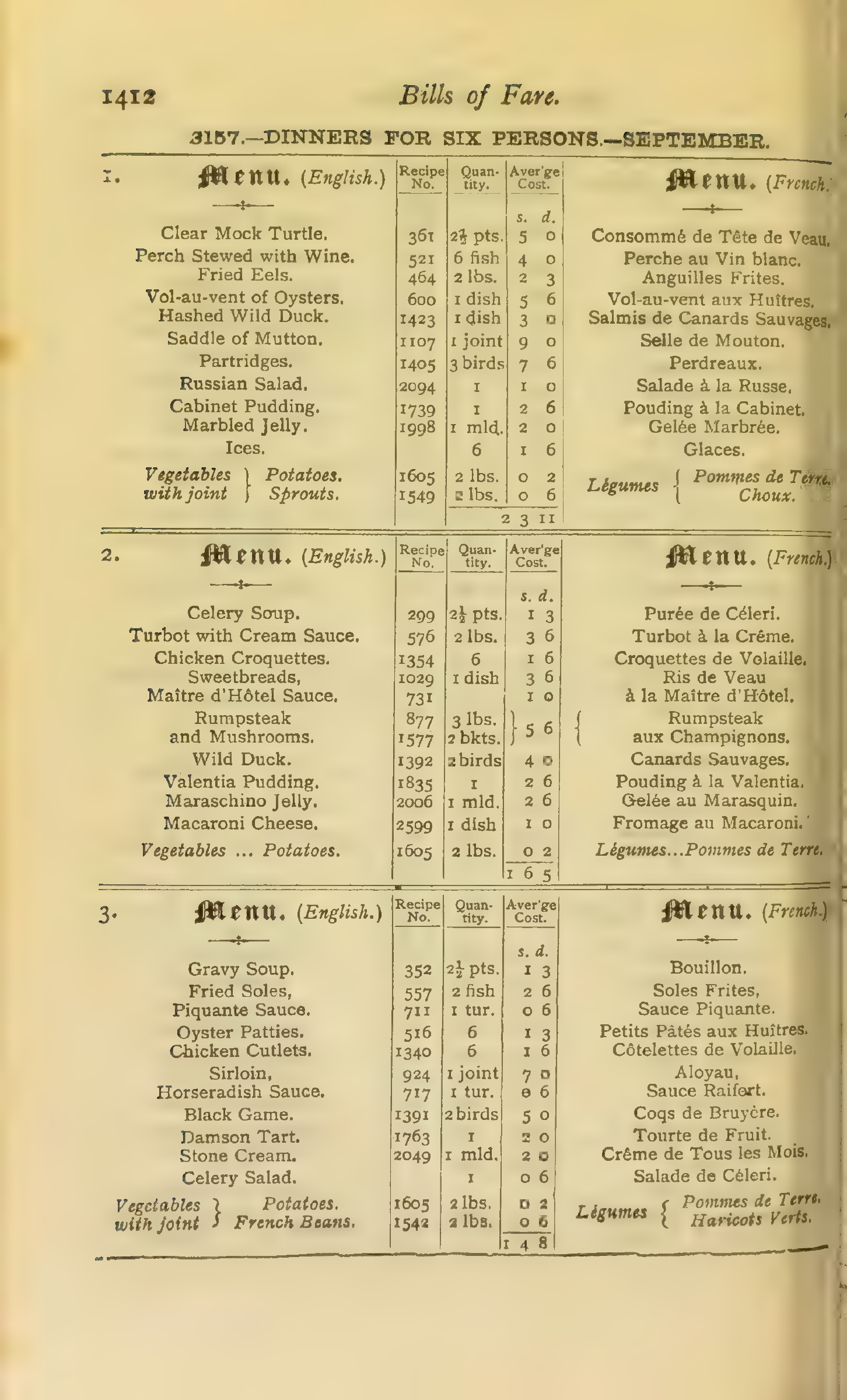
A recommended dinner and estimated prices printed in the book, not a household bill or a record of actual consumption. Catalogue date 1899; preface dated November 1888. No exact market-price year is established. The eleven priced entries below follow the English menu. They are priced lines, not a claim about the number or order of courses served.
Printed p. 1412. View the complete scanned page.
| Menu entry / recipe | Quantity as printed (expanded) | Average cost | Old pence |
|---|---|---|---|
| Celery Soup 299 | 2½ pints | 1s. 3d. | 15 |
| Turbot with Cream Sauce 576 | 2 lbs. | 3s. 6d. | 42 |
| Chicken Croquettes 1354 | 6 | 1s. 6d. | 18 |
| Sweetbreads 1029 | 1 dish | 3s. 6d. | 42 |
| Maître d’Hôtel Sauce 731 | Not separately specified | 1s. | 12 |
| Rumpsteak and Mushrooms 877 + 1577 | 3 lbs. rumpsteak; 2 baskets of mushrooms | 5s. 6d. | 66 |
| Wild Duck 1392 | 2 birds | 4s. [0d.] | 48 |
| Valentia Pudding 1835 | 1 | 2s. 6d. | 30 |
| Maraschino Jelly 2006 | 1 mould | 2s. 6d. | 30 |
| Macaroni Cheese 2599 | 1 dish | 1s. | 12 |
| Potatoes 1605 | 2 lbs. | 2d. | 2 |
| Printed total / reconciled sum | £1 6s. 5d. | 317 | |
1s. = 12d.; £1 = 20s. = 240d. The eleven menu amounts sum to 317d., which equals £1 6s. 5d. Shares are each line’s pence divided by 317, rounded to one decimal place. The per-person mean is 317 ÷ 6 = 52.8333…d., displayed as about 52.83d.; this is arithmetic, not an observed portion price or a historically quoted decimal amount. Rounded shares may not sum to exactly 100%.
Menu No. 2, p. 1412, section 3157, was checked against the scan. Rumpsteak and mushrooms share a single bracketed 5s. 6d. price: the combined amount is counted once. The wild duck’s pence digit is ink-obscured; zero is restored from the visible 4s. and reconciliation with the printed total. The Maitre d’Hotel sauce line supplies recipe no. 731 and 1s. but no independent quantity. All other row quantities and recipe numbers are transcribed below. Abbreviations are expanded in the display. Recipe 2006 is titled Liqueur Jelly, and names Maraschino as an option: it is the menu’s numbered reference, not a separate recipe titled Maraschino Jelly.
The menu prices 2½ pints at 1s. 3d. Recipe 299 on p. 149 separately quotes 9d. per quart. These figures do not reconcile by simple volume scaling; we preserve the menu estimate rather than silently replacing it with a recipe-based calculation.
Recipe 299 requires cutting celery, boiling, passing it through a sieve, adding stock, simmering, and finishing with cream or milk. It states one hour, but gives no separate allocation of active work, fuel or cleaning.
A sieve is explicitly named. A cooking vessel is implied by boiling and simmering; no specific material or equipment purchase is required by the wording.
Recipe 299, printed p. 149The menu’s numbered recipe starts with remains of cold turbot. It tells the cook to remove skin and bone when the fish comes from table to reduce waste. The 3s. 6d. menu estimate does not explain how the previously cooked fish is valued.
Recipe 576, p. 270, calls for trimming and cutting the cooked fish, melting butter in a stewpan, briefly simmering the sauce and warming the fish. Its stated ten minutes does not include catching, buying, originally cooking or storing the fish.
A stewpan is explicitly named. The recipe does not establish ownership of a copper vessel, a refrigerator, or any specific fuel system.
Recipe 576, printed p. 270The menu supplies six croquettes, recipe no. 1354, and an average cost of 1s. 6d. Method, ingredients and equipment have not been checked in this research pass; no preparation-time claim is made.
The menu lists sweetbreads separately from their Maitre d’Hotel sauce. The two prices are kept as separate entries. Method and portion size have not been verified here.
The printed sauce line has recipe no. 731 and a 1s. price but no independent quantity. We do not invent a sauce volume or fold its cost into the sweetbreads.
A printed brace groups the steak and mushrooms under one price. At 66d., this is the largest priced entry, about 20.8% of the total. The source does not divide the price between meat and mushrooms, so neither do we.
The pence digit is ink-obscured. Zero is an editorial restoration consistent with the visible 4s. and the printed total after summing the other entries. This uncertainty is retained rather than presented as a perfectly clear reading.
The menu names one pudding at 2s. 6d. A six-person dinner heading does not establish equal pudding portions; method and yield have not been checked here.
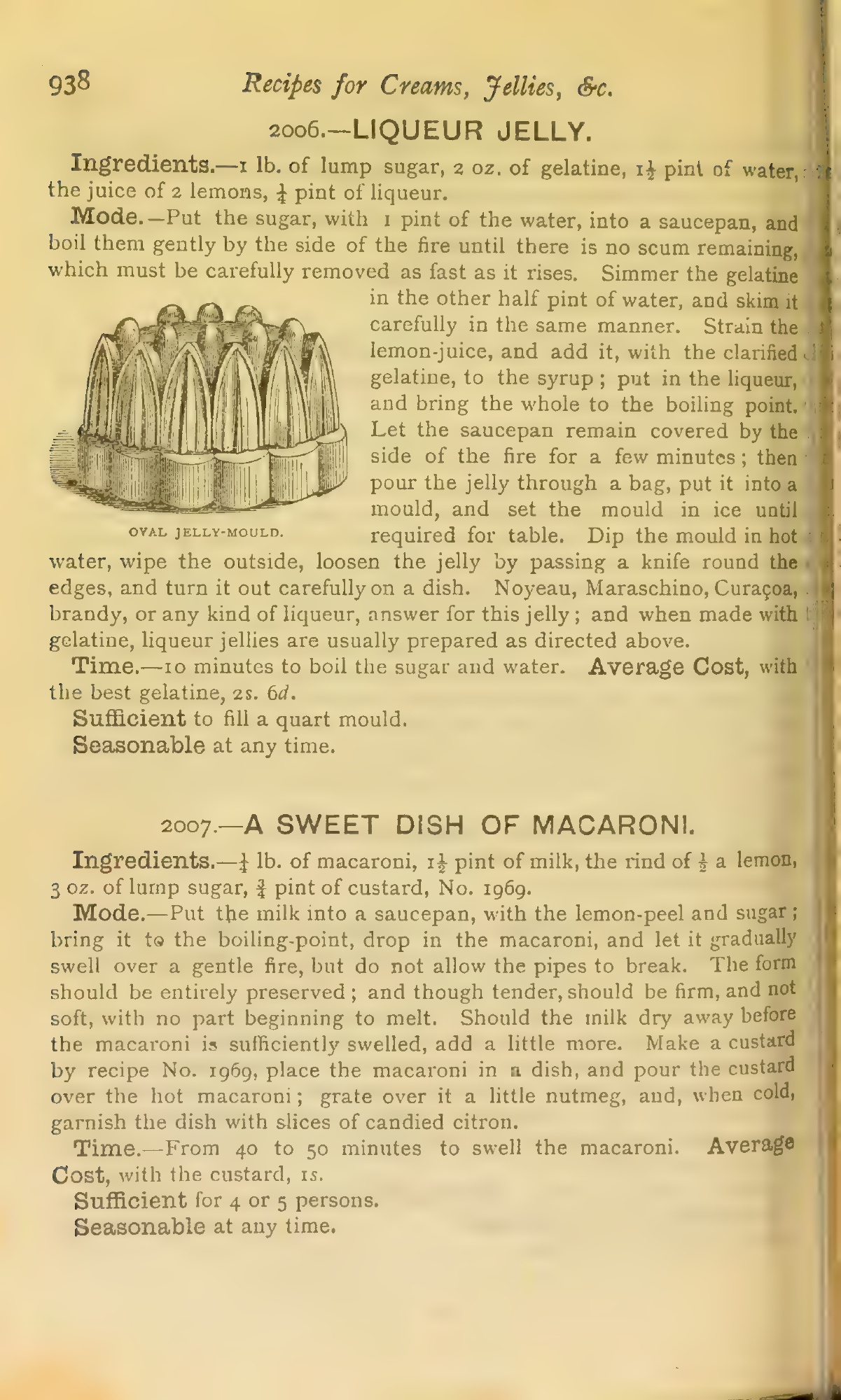
The referenced recipe is Liqueur Jelly, no. 2006, p. 938. Its method names Maraschino among suitable liqueurs. The recipe’s 2s. 6d. average cost with best gelatine matches this menu line; its stated yield is a quart mould.
Recipe 2006 requires heating and skimming syrup and gelatine, straining lemon juice, filtering the jelly through a bag, setting a mould in ice, and unmoulding. Its ten-minute time line applies only to boiling the sugar and water, not making and setting the whole jelly.
A saucepan, filtering bag and mould are explicitly named, and the method calls for ice. The quoted copper moulds elsewhere are examples from an equipment list, not proof that copper was necessary or used for this dinner.
Recipe 2006, printed p. 938The menu supplies one dish and a 1s. estimate. No precise serving weight, ingredient quantity or labour duration is established in this pass.
Potatoes are the smallest priced entry: 2d. for 2 lbs., about 0.6% of the dinner estimate. This is the cost assigned to the menu item, not evidence that preparation and fuel were free.
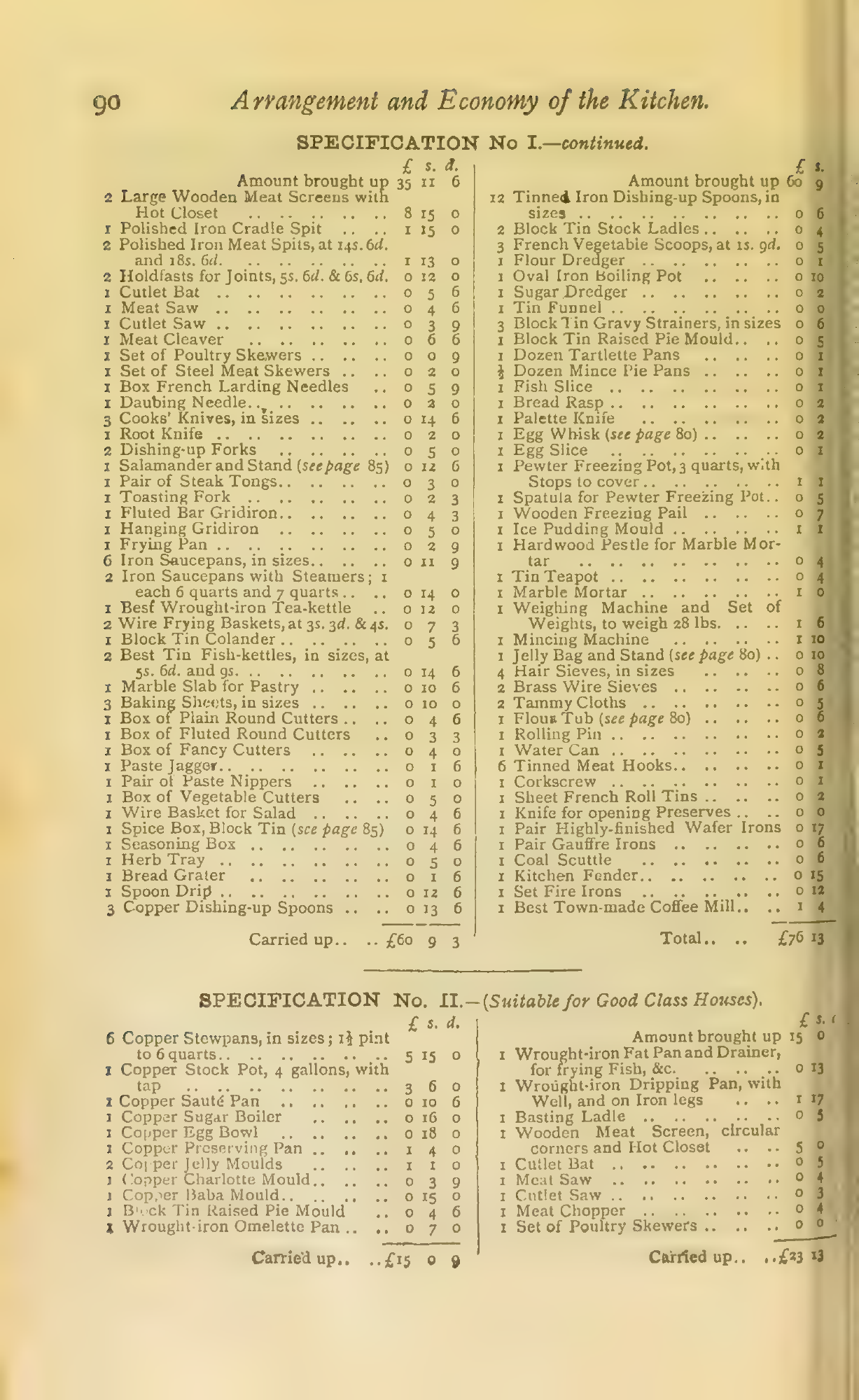
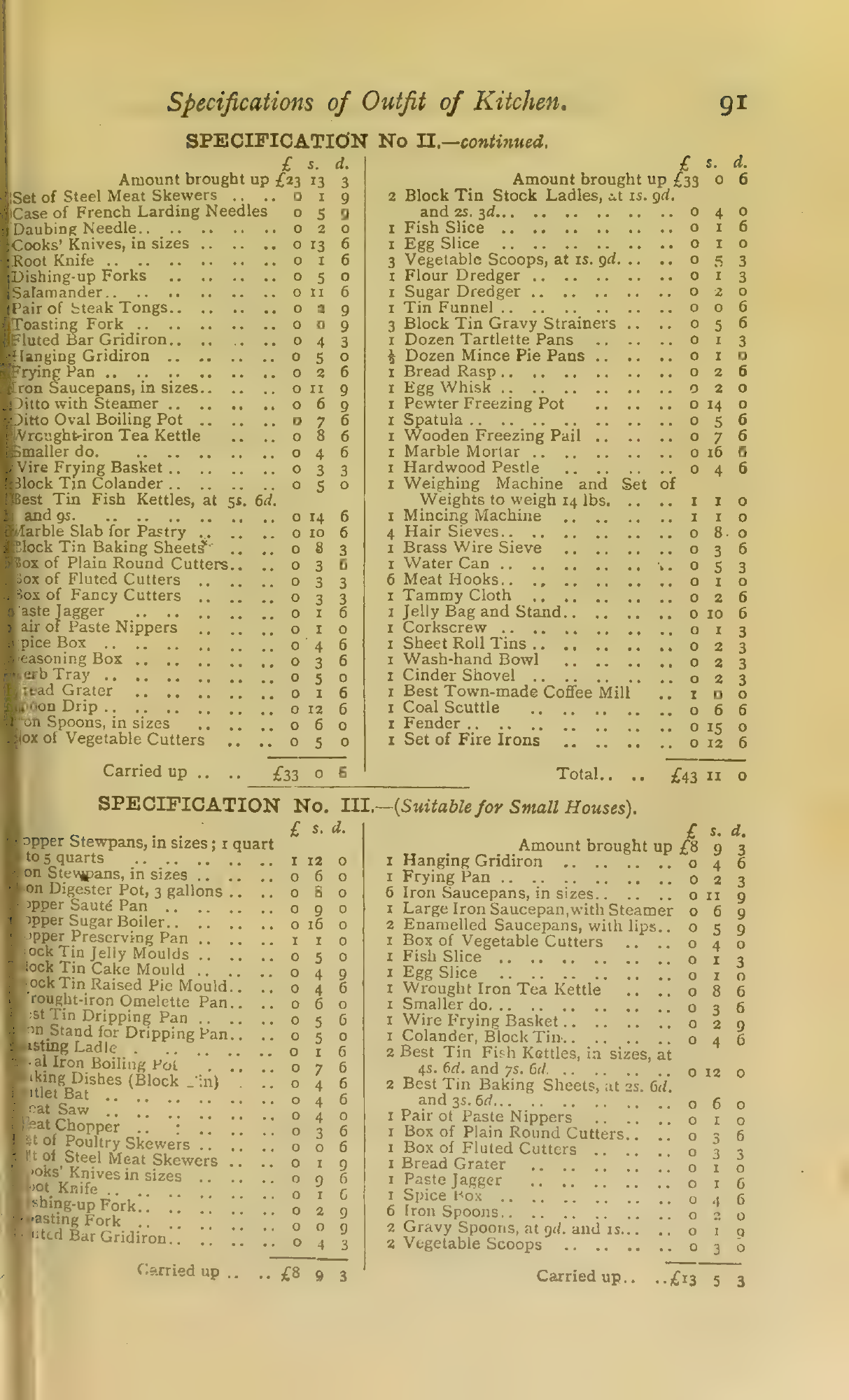
On p. 89 the book says the utensil specifications are drawn from the catalogue of Messrs. Adams and Son, furnishing ironmongers, and offers a 10 per cent cash discount. We show the printed list quotations before that discount. The specifications divide households by means and size; their class labels are the manual’s language, not classifications assigned by this exhibition. These are illustrative reusable purchases, not a minimum kitchen budget or the actual possessions of the dinner’s consumers.
Two copper jelly moulds — £1 1s. (p. 90). Specification No. II, headed ‘Suitable for Good Class Houses.’ The amount is for two moulds together, not one. It is a supplier-based purchase quotation, not a cost incurred each time jelly is made. Source image.
Jelly bag and stand — 10s. 6d. (p. 91). Specification No. II, continued. The liqueur-jelly method names a bag but does not require this particular stand or prove that it was purchased. This quotation is separate from the meal estimate. Source image.
Fuel and heat. The menu has no separate fuel line. Cooking methods require heat, but the stove, fuel, consumption and price for this dinner are unknown. No fuel surcharge has been invented.
Work and service. Wages, preparation, serving and cleaning are not separately itemised in the dinner table. The source does not define a complete accounting boundary, so absence of an itemised charge is not proof it was excluded from every estimate.
Cooling and storage. The jelly method calls for ice and the turbot starts with cooked remains. The menu provides no separate ice or storage charge and no equipment inventory for the hypothetical household.
Earlier preparation. Stock and already cooked fish carry prior inputs. The printed menu does not tell us how those inputs were allocated between meals. A recipe’s finishing time cannot recover their complete cost.
The occasion beyond the listed food. No separate wine service, table linen, lighting or room costs are listed. We cannot assume which were supplied, how they were paid for, or that this was an observed dinner party.
Original illustrations from The Book of Household Management, University of Leeds Library copy, Internet Archive b21536193 (catalogued 1899). The item carries a Public Domain Mark.
Full-page JPEGs rendered from the source PDF without restoration, recolouring or generated content. Two illustration details are cropped from the existing page scans with their printed captions retained. Cropped details are labelled as such; complete source pages remain available. Gallery thumbnails may show only part of a page; the viewer opens the complete supplied image.
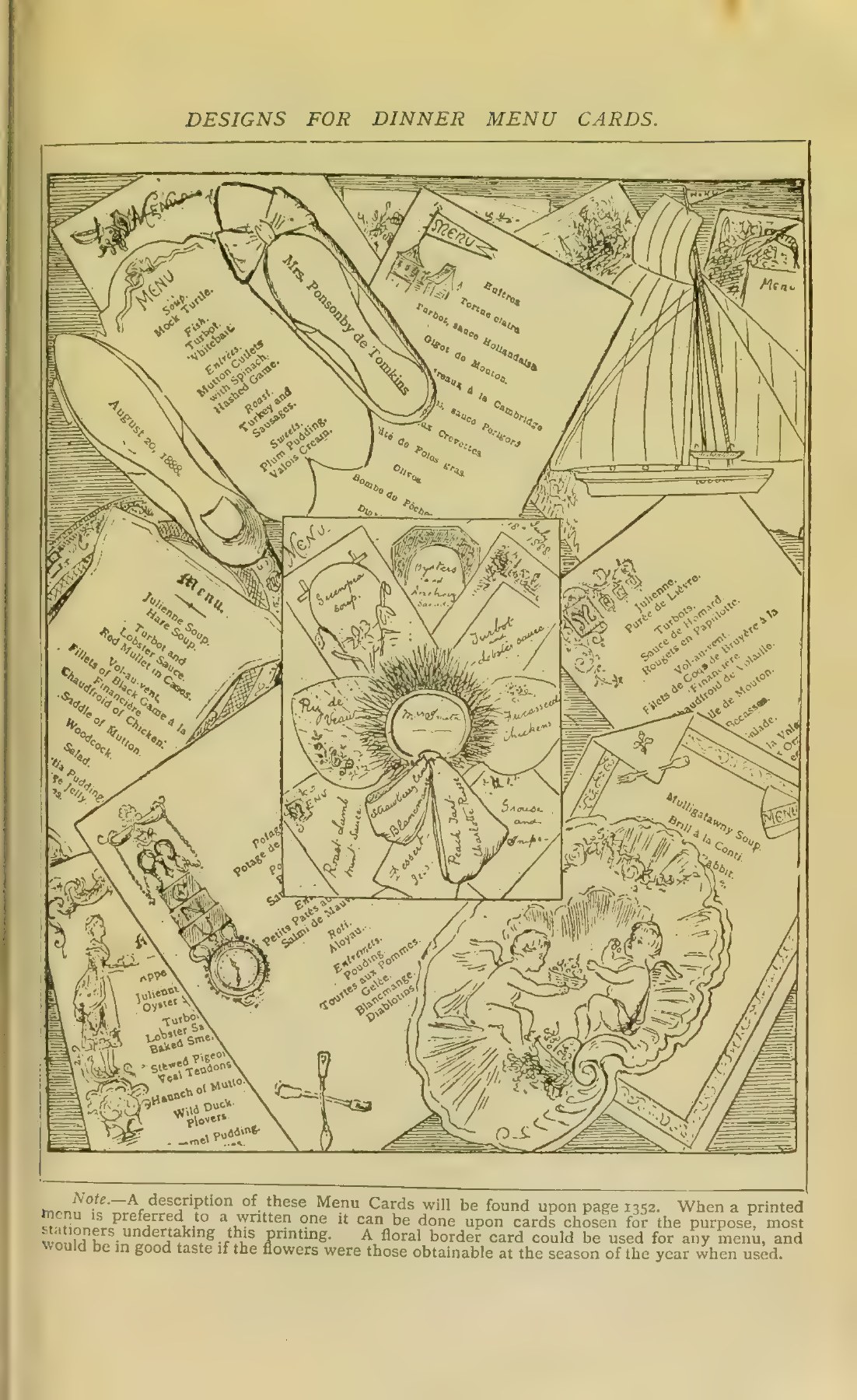
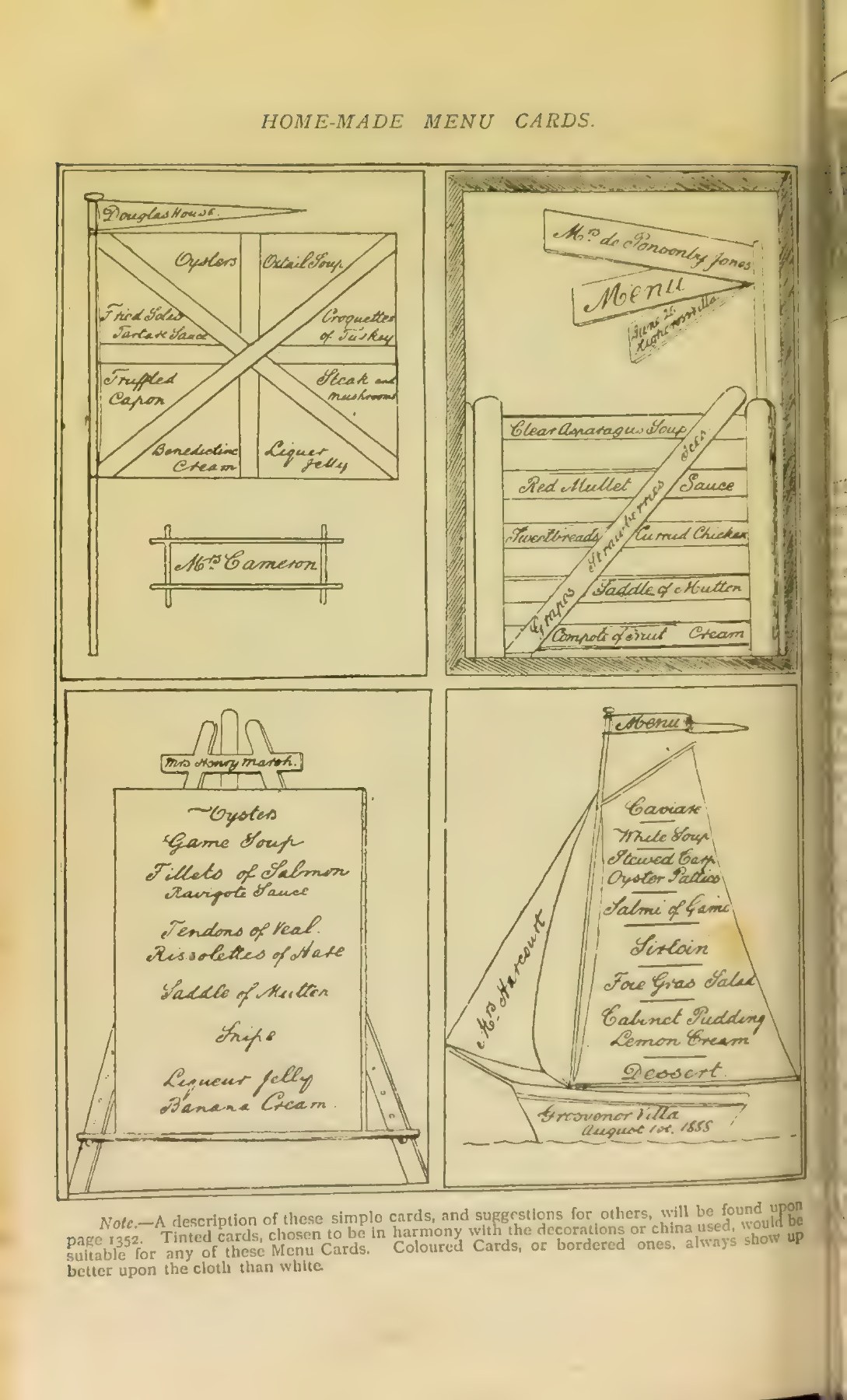
Unnumbered illustration near p. 1350; source PDF page 1461
A page of ornamental menu-card designs. These are examples of presentation, not records that the depicted dinners were served.
View supplied image · Source PDF location
Unnumbered illustration indexed near p. 1351; source PDF page 1458
The book presents menu cards as objects that can be made and decorated. Their handwritten-style sample menus are design examples; we have not transcribed their dishes into the researched collection.
View supplied image · Source PDF location
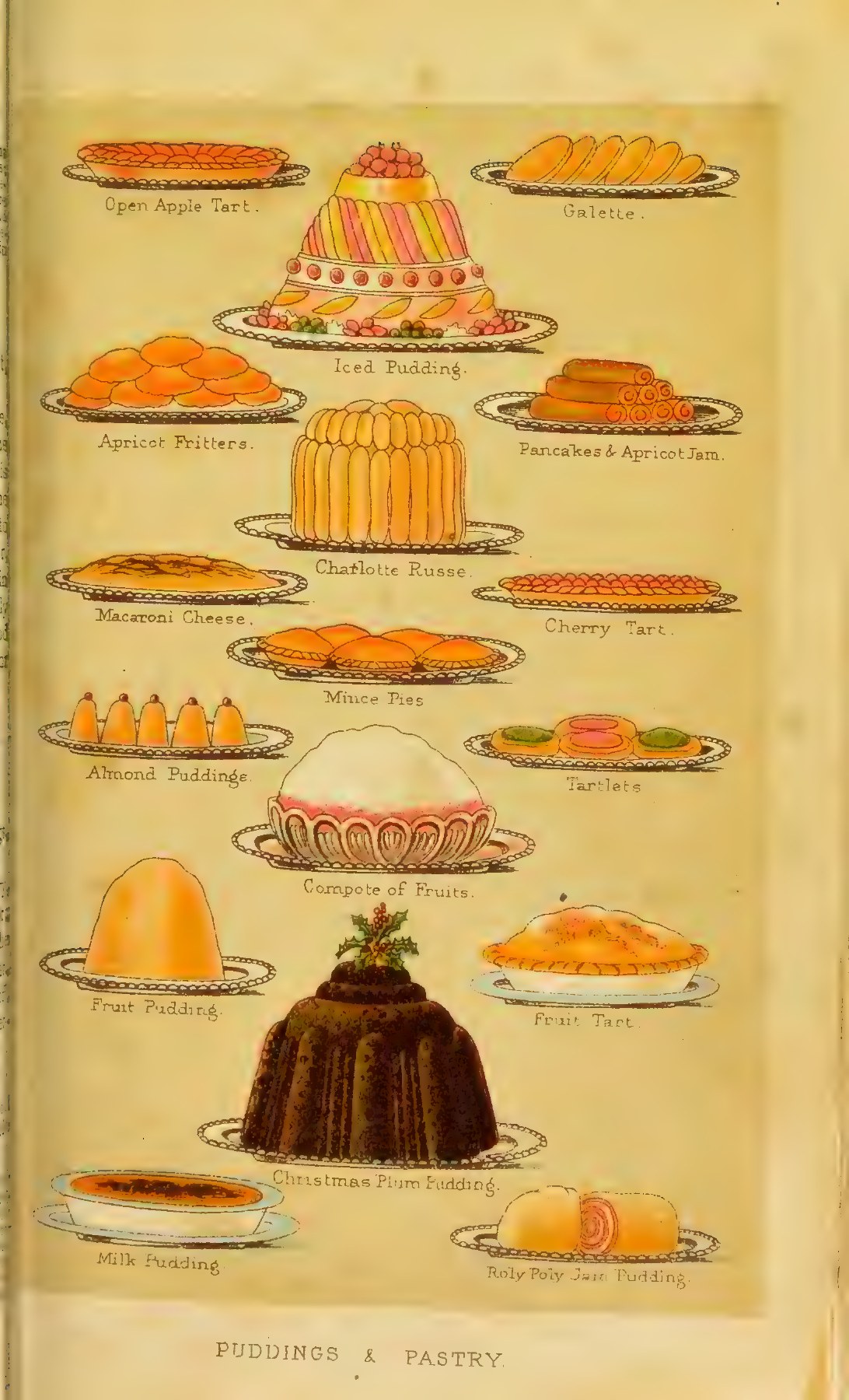
Plate 8, indexed to face p. 804; source PDF page 895
A colour plate of prepared dishes, including tarts, puddings and macaroni cheese. It illustrates the book’s visual repertoire; it does not document the appearance of our selected dinner.
View supplied image · Source PDF location
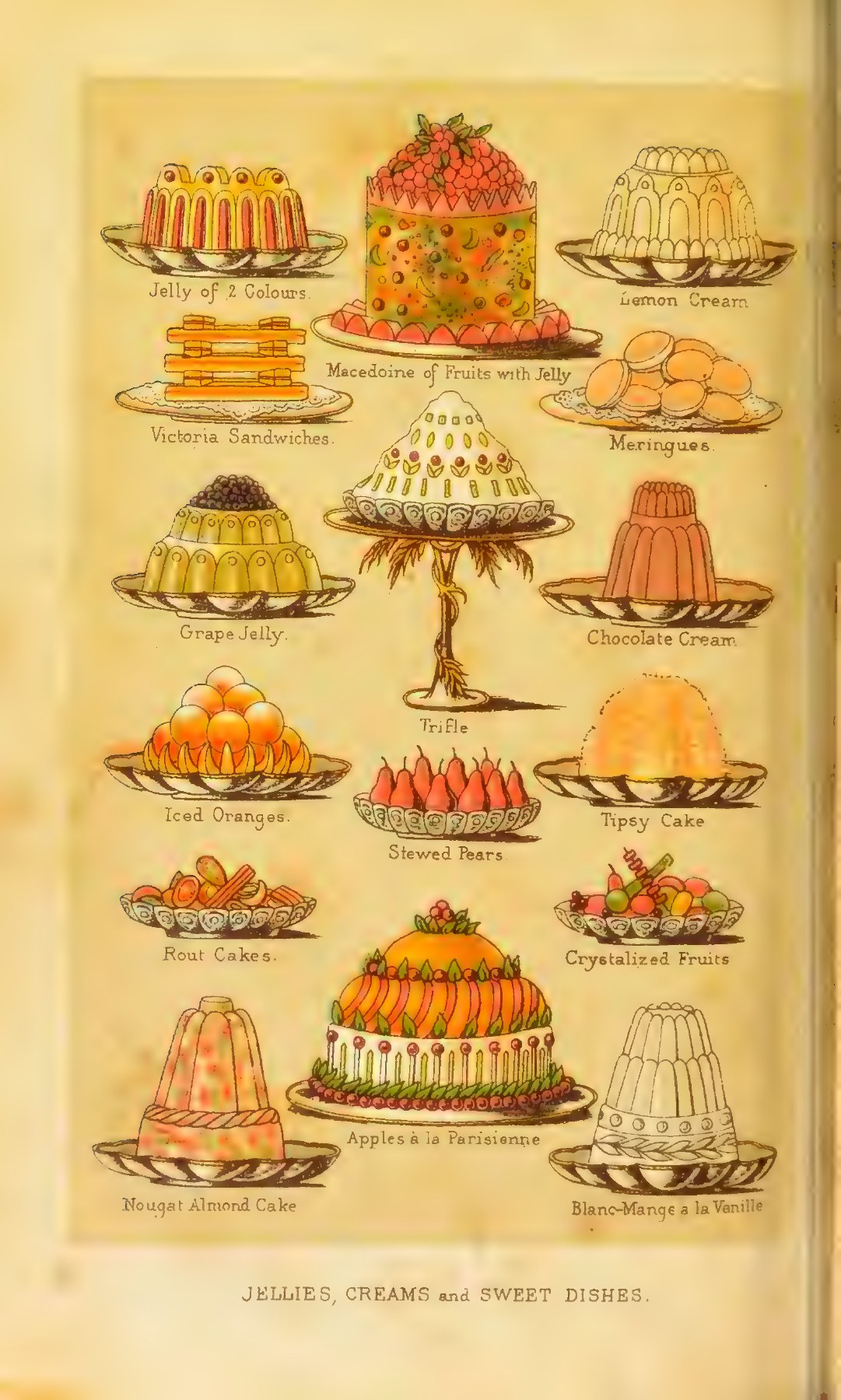
Plate 9, indexed to face p. 931; source PDF page 1026
The labels distinguish jelly of two colours, lemon cream, trifle and other sweets. Lemon cream is not our Lemon Jelly recipe, and none of these images is labelled as our menu’s Maraschino Jelly.
View supplied image · Source PDF location
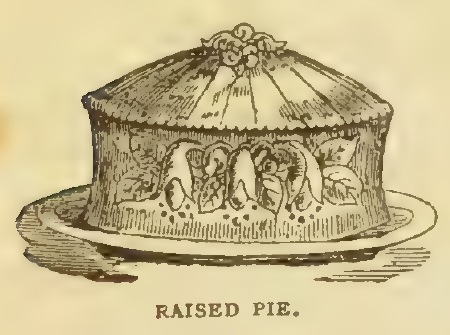
Printed p. 870, beside recipe 1852; source PDF page 964
An illustration printed alongside recipe 1852, Raised Pie of Poultry or Game. This cropped detail retains its printed caption; open the source page to see the recipe and illustration together.
View supplied image · Source PDF location · Complete source page
Printed p. 938, within recipe 2006; source PDF page 1036
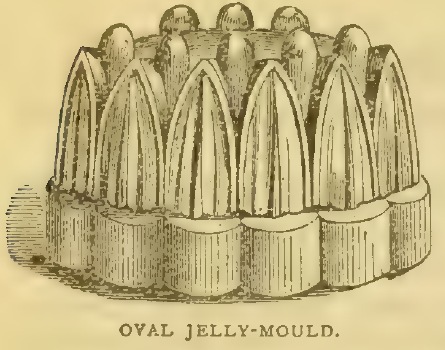
A mould illustrated within Liqueur Jelly, recipe 2006, the recipe referenced by our Maraschino Jelly menu entry. This is equipment, not a picture of finished Lemon Jelly.
View supplied image · Source PDF location · Complete source page
Source discovery / Beeton / p.797
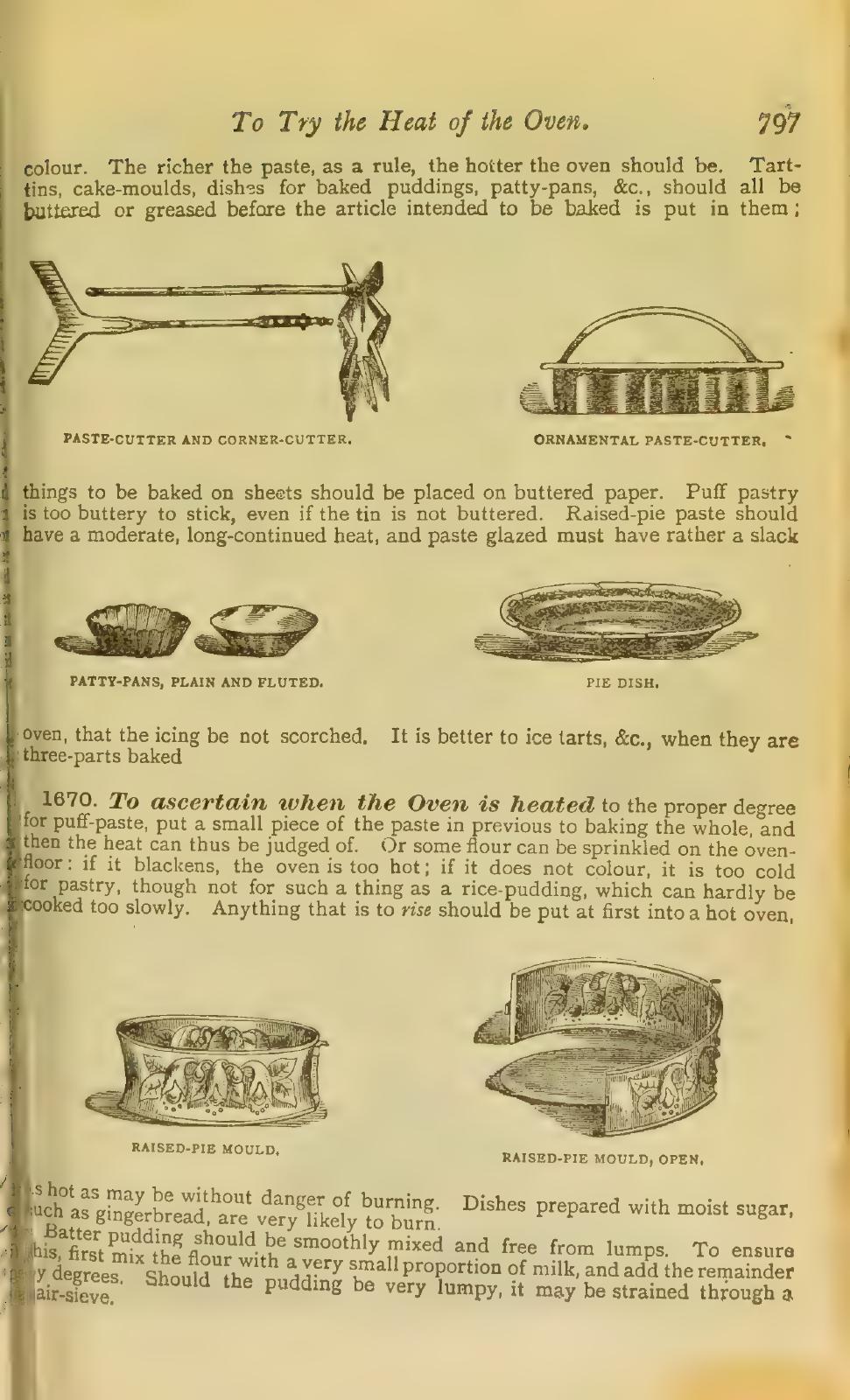
The reference points to printed p.797: two illustrations below paragraph 1670 show the raised-pie mould assembled and open. Paragraph 1670 itself concerns testing oven heat; it is not a mould-making instruction.
Recipe 1852 sends the reader here before lining the mould with pastry. The book thus supplies both an instruction and a picture of the equipment it assumes.
Interpretation: An illustrated cross-reference makes the material requirements of culinary display visible.
Limit: Neither page identifies an actual owner, a manufacturer, a material or a price.
Separate American comparison / Boston / reported event results / historical US dollars
The movement’s 1902 history reports results for the events named in Burr’s cookbook and a further Boston bazaar. Read the accounting labels before comparing the amounts.
$6,000
Described as “cleared.” Printed p.704.
≈$8,000
Nearly this amount in gross receipts; a separate event. Printed p.705.
$2,346
Gross receipts, with Charlotte H. Allen supervising arrangements. Printed p.707.
These are event totals. The source does not isolate cookbook sales or the cookbook’s contribution to them. Gross receipts and a sum described as cleared are different measures; this is not a comparable profit series.
Susan B. Anthony and Ida Husted Harper, eds., History of Woman Suffrage, vol.IV (Rochester, NY: Susan B. Anthony, 1902), chapter XLV, pp.704–707. Chapter material is credited to Alice Stone Blackwell (chapter-source footnote303 in Gutenberg). Inspected: the specified Gutenberg passages, cross-read against Wikisource; no original cashbook or page-image check.
Interpretation: Event-level fundraising results are now documented as reports, extending the title page’s declared aims.
Limit: The 1902 movement history is retrospective and written by participants. Its figures have not been reconciled with accounts; cookbook-specific income, expenses and transfers remain unknown.
Original treasurer’s reports found / Washington / 1909–1911
The original reports separate the cost of the batch from money received. They correct the financial reading while leaving unit sales open.
Eaton’s report through 30 November 1910 is explicitly marked not final. Its January 1911 update gives this cumulative cookbook statement:
$1,351.01
A batch cost in historical US dollars. It is not a count of 1,351 copies sold.
$1,017.70
A dollar total. The report does not supply a matching count of copies sold.
$333.31
The source says covered. It does not describe this sum as an unpaid deficit still to be raised.
The two amounts sum to the stated cost: $1,017.70 + $333.31 = $1,351.01. Bar lengths represent these reported dollar amounts, not books or political influence.
Cora Smith Eaton, Treasurer’s Report, from June 16th, 1909 to January 10, 1911, manuscript p.4, archive item 14748, identifier SL_devoe_000955.jpg. Washington State Library, Emma Smith DeVoe papers, WSL Manuscripts, MS 171, Box 2; digitised in Washington State Women’s History Consortium, collection devoe, parent item 14928 (Letters from Cora Smith Eaton). All five pages visually inspected. Open the original page image.
Resolved for this account: cost, sales receipts and the reported role of donations are distinct. The entry $1,351.01 is a cost; it supplies no evidence for 1,351 copies sold. The $333.31 is described as covered, rather than remaining an uncovered loss.
Still open: the 1922 history’s assertion that 3,000 copies were sold is not verified by these cash reports. A batch of 3,000 and receipts of $1,017.70 cannot establish unit sales without evidence of prices actually received, free distribution, credit and unsold stock. The November report has not been identified as the exact item cited as Eaton 1910 in Williams’s bibliography.
Interpretation: cookbook publishing required a combination of trading receipts and voluntary contributions. A political use for a book can coexist with sales that did not cover its stated cost.
Download the inspected account data and source identifiers · Download the checked financial lines
Food & social activity / a separate Washington case
Follow four documented or reported settings: personal canvassing, club discussions, fair booths and collective hospitality.
